
The human capital engine
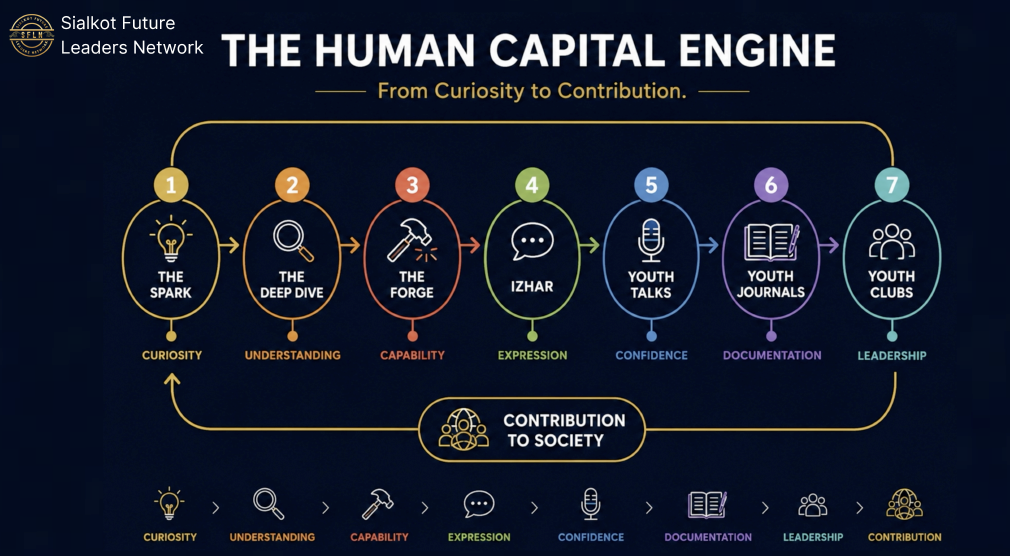
From Curiosity to Contribution — the seven-stage system every SFLN child moves through, every week, at every age.
the rationale
Why Early Interventions Provide the Real Leverage
A NASA study on divergent thinking found that 98% of five-year-olds score at genius level. By adulthood, roughly 2% do. The conventional system doesn’t fail to build creativity — it erases it, year by year, by rewarding imitation and penalizing risk.
Economist Paul Romer’s endogenous growth theory holds that long-term economic development is driven by human capital creating new ideas not by manual labour or physical capital alone. The World Bank’s Changing Wealth of Nations study confirms it at scale: human capital drives 64% of global wealth, more than physical and financial capital combined. On the 2025 Global Innovation Index, Pakistan ranks 99th of 139 economies overall, and 14th of 37 within its own lower-middle-income peer group.
Every existing intervention, Chamber of Commerce programs, government schemes, university incubators, arrives after graduation, ages 22 to 25, once the habits of thought are already locked. SFLN intervenes at the actual leverage point instead.

Phase 1: The Spark
A brain under zero resistance atrophies. Each week, every child gets a complex, unstructured dilemma deliberately beyond comfort zone — Harvard’s Productive Failure framework. No answer key: what’s graded is the route mapped and the questions the struggle generates. Example: before any physics lesson, a child is asked whether a bee in a moving car must fly forward to keep up — most adults get it wrong. NextGen personalizes the same resistance to the family’s real industry instead of a generic case study
Phase 2: The Deep Dive
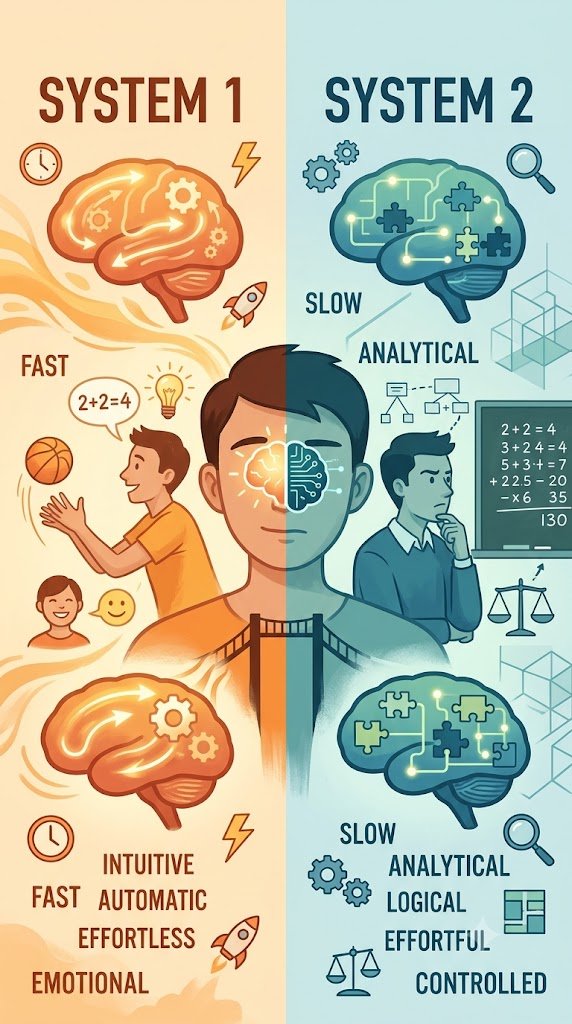
Where The Spark ends at a question, The Deep Dive trains a child to distrust the first answer — Kahneman’s System 1 vs. System 2. The method: ask “why” five layers deep instead of stopping at the first symptom, as in the 1980s NYC subway crisis, where more guards helped briefly but only the root-cause fix solved it for good. Example: the bat-and-ball riddle — instinct says the ball costs 10, the answer is 5. For NextGen, this personalization lands later — Leaders/Stewards age, with parent sign-off.
Phase 3: Izhar (The Voice)
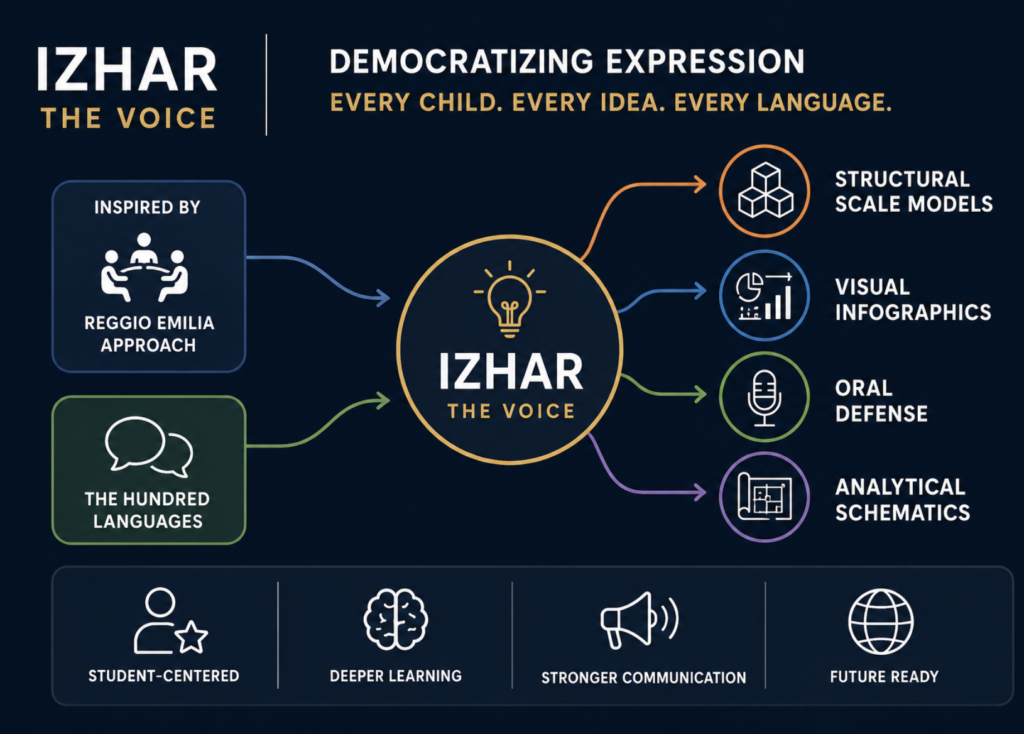
A child has a hundred languages for thinking — building, drawing, oral defence, schematic mapping. School steals ninety-nine of them by forcing everyone through a pencil and a test. Izhar gives every child a landing space in whatever form actually fits them. Example: a child who can’t write a strong essay isn’t “uncreative” — they might build a scale model instead, or map an infographic, or defend an idea out loud. For NextGen, Izhar becomes The Profile — every submission dated and archived into a permanent, verifiable portfolio.
Phase 4: The Forge
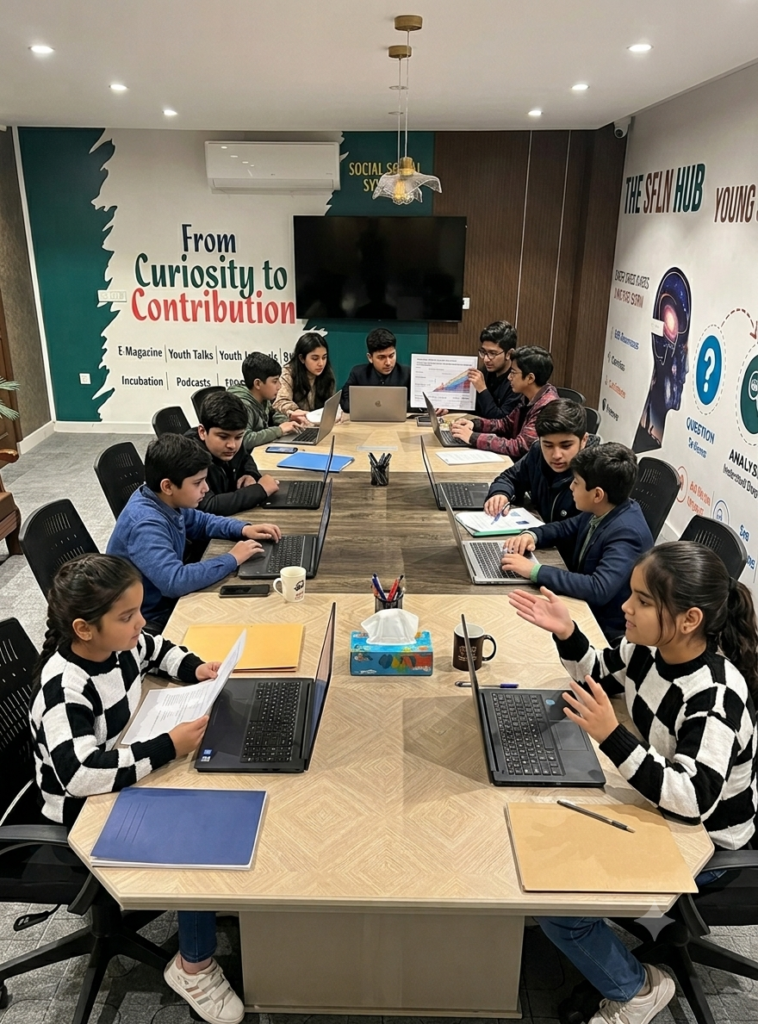
Raw curiosity, like ambient light, has no power until it’s focused. The Forge is that lens — arming curiosity with structural knowledge, historical grounding, and an ethical compass. Example: children learn algebra is Arabic — al-jabr, Al-Khwarizmi — anchoring them in a real lineage of innovators, not a borrowed one. For NextGen, this becomes a capped cohort of 4–6 children, led personally by Najam, on a fixed weekly cadence.
Phase 5: Youth Talk
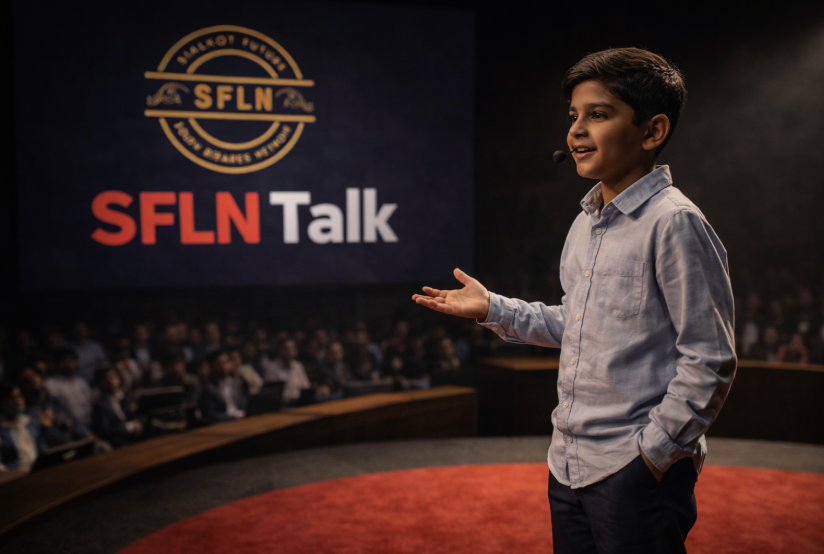
Fewer than 5% of students — the already-confident — ever get a stage; the other 95% learn their voice doesn’t matter. Youth Talk is a right of passage for every child; the only metric is the conquest of self-fear, not a trophy. Example: this stage exists because Najam stammered, was bullied for it, and was pushed onto a stage by his mother — he lost the debate but found his voice. For NextGen, stage time is guaranteed, not rotational, presenting to Chamber and industrialist audiences by Leaders/Stewards age.
Phase 6: Youth Journals (The Memory)
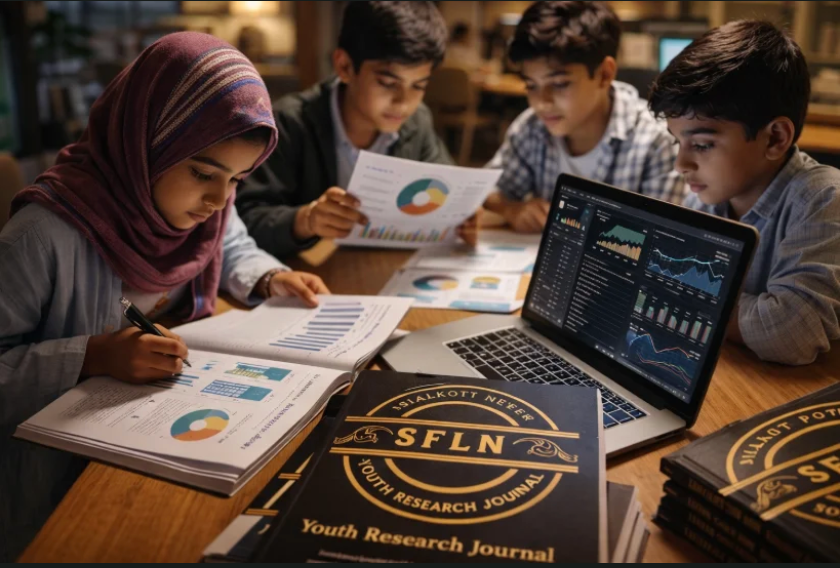
Most institutions hoard data out of scarcity. SFLN’s Youth Research Journal does the opposite: every project is peer-reviewed and documented, including its failures. Example: a team of Builders spends four weeks on a composting prototype; the chemical balance fails; the full methodology gets documented anyway, so failure becomes shared data, not shame. For NextGen, this becomes a structured International Recognition Roadmap.
Phase 7: Youth Clubs (The Tribe)
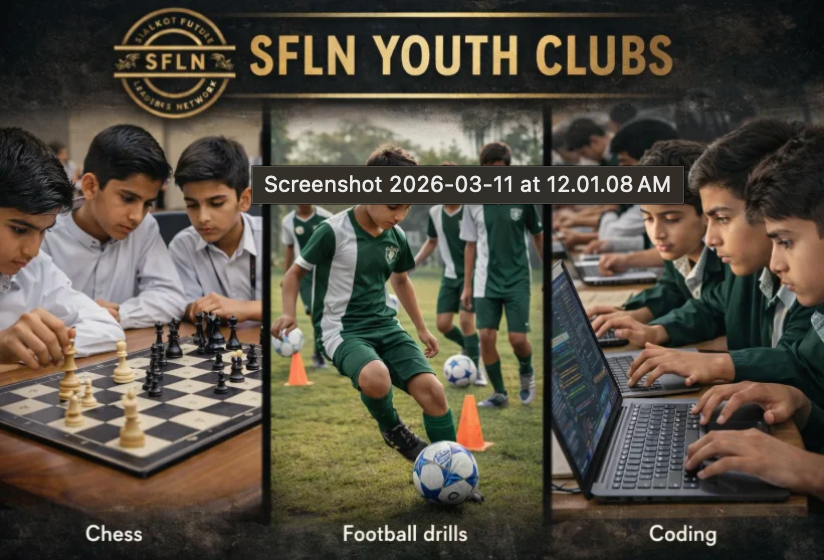
Stanford research holds that learning velocity and resilience multiply with real tribal belonging. Children form self-governing clubs, writing their own constitutions. Example: scale a club past 20 active members and it bypasses standard hierarchy into the Young Leadership Program; every graduating Leader returns to mentor incoming Explorers. For NextGen, children found clubs from day one, fast-tracked into YLP without the 20-member trigger.
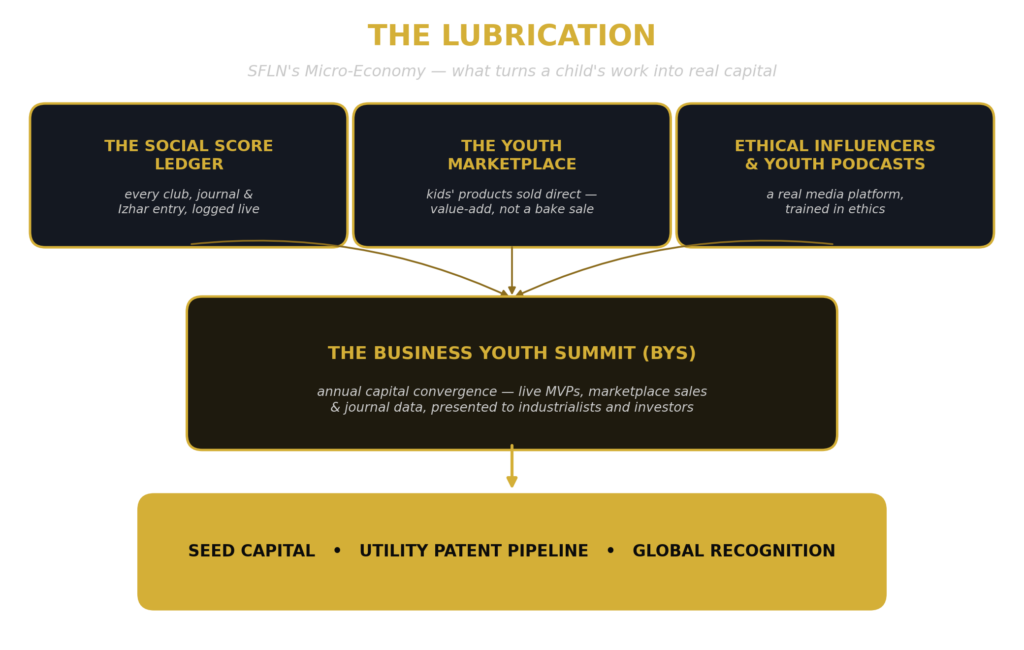
The Lubrication — SFLN’s Micro-Economy
An engine without lubrication grinds and seizes. In a conventional school, a child can spend months building something remarkable and receive zero structural credit for it — the only recognized currency is a mark on a report card. SFLN replaces that with a real, live incentive economy running underneath all seven stages.
The Social Score Ledger — a live, dynamic portfolio embedded in every child’s profile. Every club sponsorship, Research Journal entry, and Izhar submission updates it in real time. Through a Chamber of Commerce partnership, it’s designed to become an institutionally accredited passport — redeemable for scholarships, masterclass access, and retail discounts across the city.
The Youth Marketplace — a dedicated, city-wide e-commerce channel exclusively for products children actually build: published e-books, schematics, structural designs, physical inventions. The goal is value-addition — a designed product commanding a real premium — not the standard school “bake sale.” One SFLN Builder identified a gap in the market, sourced her own materials, and built a fully realized product from scratch; the Marketplace exists so that work has a genuine storefront instead of staying a school-fair curiosity.
Ethical Influencers & Youth-Led Podcasts — children who produce strong Research Journal work earn a real platform: a podcast mic and a media presence, trained in communication, data literacy, and media ethics — positioned deliberately against low-substance influencer culture, not imitating it.
The Business Youth Summit (BYS) — the annual capital-convergence point of the entire ecosystem. Children present live MVPs, validated marketplace sales, and open Journal data to an audience of industrialists, investors, and Chamber leaders. Where a child’s work is genuinely original, SFLN aims to fast-track it into a formal Utility Model Patent pipeline and open the floor for real seed capital on the summit stage itself.